Traintastic currently supports the following digital systems:
DCC-Ex
Digitrax LocoNet
ECoS
HSI-88
Lenz XpressNet
Marklin CS2/CS3
Selectrix (under development, needs testing)
Z21
There are many more systems out there, and I’d like to get a sense of what’s most important to add next. Adding support usually means quite a bit of development and testing work.
A little background: testing is a crucial part of development. If I (or another developer) have the hardware available, it makes development and debugging much easier. Unfortunately, I can’t buy every digital system myself — it would simply be too expensive. That’s why community help is so valuable here. If you already use a system, your feedback and testing can directly influence whether and how quickly support gets added.
Questions for you:
Which digital system(s) do you use on your layout?
What specific features are essential for you (e.g. programming CVs, handling long addresses, accessory control)?
Would you be willing to help with testing, or provide protocol information / feedback if support for your system is being developed?
The more input and assistance we have, the better we can prioritize and build reliable support for the systems that matter most to the community.
I own an YD7010. If any testing is required I’m happy to assist. I assume running at as a DR5000 works. I’ll have the time for some testing next week, probably.
It should be compatible with the DR5000 indeed, one thing that might be different is the default port numbers used for the network protocols, the DR5000 allows only one to be active, the YD71010 support multiple at the same time I’ve read.
I’d love to hear the test results, based on that the documentation and the interface setup wizard can be updated if required.
I think digitrax and NCE are well regarded here.
Probably roco/esu but certainly not as widely available ( quick google )
I run DCC-ex and consider going to MERG CBUS because of a physical handset.
Also from what i can gather NCE is “finicky”.
JMRI has it up and running but i dont like what i read sofar.
I think for our target audience these: Digitrax / Yamorc / Esu / Roco and it’s expresnet cousins may be of more value.
But future / your wisdom / other demand should tell us more.
The main challenge is always having testing hardware, I did CBUS without hardware, but that protocol is well documented…NCE on the other hand is undocumented and has all kinds of quicks I’ve read.
After completing CBUS/VLCB and DINAMO, my next preference is BiDiB, but that will depend on hardware availability or people who are willing to do testing.
CBUS/VLCB is really not well known at the European continent, it’s more present in UK. As I know, DINAMO is a system prefererd in Netherland? BiDiB is a niche product, only with hardware from Tams, Fichtelbahn and DIY, but the code is restricted. I think, due to MERG, CBUS/VLCB has far more users than BiDiB. NCE is a US product; I mean it’s difficult to get hardware in Europe, there are only some dealers in UK. I’m not sure how many Traintastic users there are or could be in the USA.
I actually think that Traintastic with Z21, LocoNet, XpressNet and CBUS pretty much covers the European market, and it might be time to shift the focus, add more features to the program and improve the documentation so that it becomes more widely used. I’m already trying to do that by writing a lot about it
Traintastic is fantastic simple and it could be really an alternative to the prorietary software!
@DL7BJ I did write a little blurb happy to discuss in my fork.
Plus Traintasic may become a serious contenders against other well known ones too ( JMRI/ rocrail i am looking at you and if have opinions on both )
At least here in NL CBUS/VLCB is rare, I asked about on a large model train forum, but only one response, so it is really a niche. For the UK market it is nice that Traintastic is new (work in progress) alternative for JMRI and RocRail.
DINAMO is an odd one, it works totally different then all other systems. It is a track driver system, you (the PC) has to send commands to blocks instead of loco’s. It allows to drive DCC and analog loco’s in mixed mode. It is a dutch product, but they have some dealers outside of the Netherlands. Most of it is already implemented on the dinamo branch, it needs some more finetuning.
Traintastic has already support for most well known digital systems, so whats left are the more niche products. The upcoming release is focused on more hardware support, after that new features is the focus. (New hardware might be added is someone is willing to provide it, like with DINAMO.)
Traintastic is fantastic simple and it could be really an alternative to the prorietary software!
That’s my big wish and long term goal I’d hope one day to walk around on a model train show and see railroads being operated by Traintastic
I’ve just joined. My interests include automation in general and developing my own modules to support this. These are typically based on Raspberry Pi Picos or ESP32s.
I’m currently developing my own RailCom project and for that I’m focusing on the Pico platform. There’s a software repository here which contains some background information about the hardware too. At the moment the hardware comprises a 4 block local detector and an integrated command station with booster, RailCom cutout and global detector. For the communication between modules I use MQTT and I think that this could be of real interest here as an additional way of providing an external communications interface that’s not proprietary and would allow those who wish to develop their own infrastructure modules a way to connect.
I’ve had a brief glance at lua and there appears to be library support for MQTT but I don’t know if that’s available in the traintastic environment. Perhaps if it is that would be good way to do some prototyping.
Awesome that you building and developing you own hardware, really nice. I’d like Traintastic to support DIY builds too. Traintastic has no support yet for MQTT, sounds interesting
Traintastic’s Lua scripting engine is sandboxed, so it is not possible to load external modules/rocks. For MQTT support has to be designed and added.
For getting RailCom information into Traintastic there is currently one option using LocoNet OPC_MULTI_SENSE messages.
I know very little about MQTT, I read about pub/sub system and a broker, thats about it, never used it.
Do you use MQTT only for communication between modules, or is their already other software involved?
I use MQTT in conjunction with JMRI at the moment, but that’s primarily because it has an MQTT interface and allows me to test my other modules with it. The broker I use is mosquitto which runs happily on a Raspberry Pi, but there are ports available for Ubuntu, macOS and Windows etc too. In addition there are also several configurable user interface applications that you can tailor to create your own screen based application screens on tablets and iPads.
MQTT messages are split into two components. There’s the topic that typically describes who you are talking to and what the message is about. This has a hierarchical nature akin to a directory structure. In a publication, the topic is fully defined, but when subscribing you can include wild cards and then you will receive any publication where the topic matches your subscription. This makes routing of messages very flexible. Then there is the payload. The content of both topic and payload is plain text which makes interpretation for debugging far easier. For some of my payloads, I’m using JSON so that the payload content is self describing. This is an example of a RailCom channel 2 payload that’s been produced by a RailCom mobile decoder and then encoded using JSON for transmission to the subscribers.
The topic is:
rcom/gbl/9/id7
I.e RailCom / global detector / dcc address 9 / message type id 7
Direction is a bit significant value – in this instance it’s up to the subscriber to decode it, but for clarity I could expand it into several Booleans.
I don’t know how Traintastic is structured internally and what libraries you have available. I’m using MicroPython and that has a built in JSON library function that makes it very easy to serialise MicroPython objects. If there’s something similar in your environment, it could provide a fast way to develop an external interface that’s vendor neutral, easy to maintain and extensible.
Hi Reinders,[quote=“reinder, post:17, topic:20, full:true”]Most users have just a single command station so there is not much to choose, in general I think the easiest to setup are:
LocoNet / XpressNet / Z21 (just set addresses)
ESU ECoS / Marklin CS (command station is intelligent too)
So ECoS should be OK for bloody beginners!
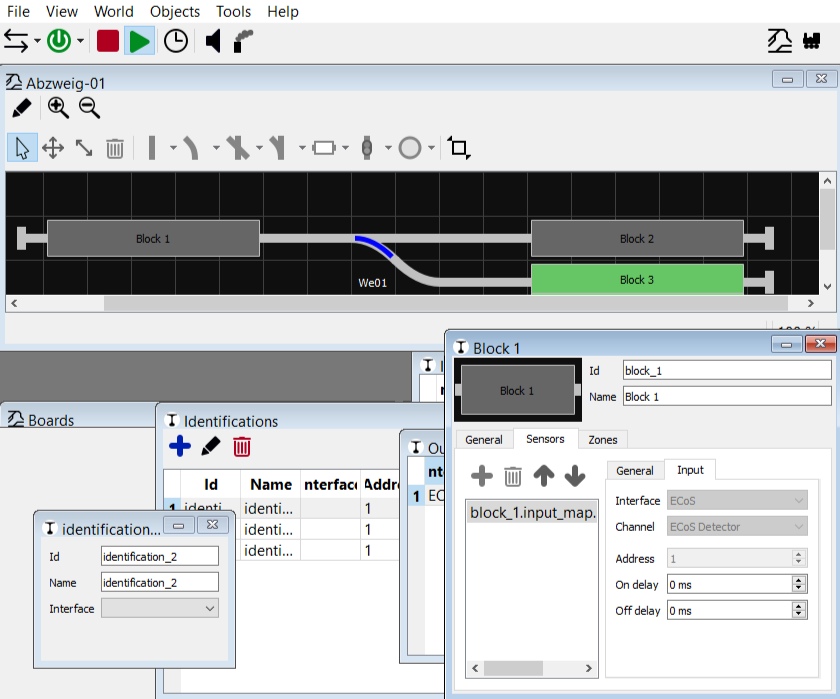
Power control and Locomotive control i got, even turnouts are now working in Traintastic, but I don’t know why. A turnout “We01” with DCC-in the ECoS s in Traintastic choice able, but this seems to be the wrong way? It’s a Trix C-Turnout with an in-build Decoder.
With Sensors and Blocks unfortunately nothing works in Traintastic, as simultaneously shown in the ECoS-Display.


 I’d hope one day to walk around on a model train show and see railroads being operated by Traintastic